


Key Takeaways on Semantic SEO’s Significance
| Key Aspect | Description |
| Human-Centric Content | Semantic SEO is user-focused. Understanding user intent, answering their questions comprehensively, and providing valuable content are essential. |
| Beyond Keywords | Context is crucial. It’s about the relationships between words, language nuances, and the intent behind queries. |
| The AI Factor | AI, particularly through tools like Google RankBrain and NLP, is transforming how search engines interpret queries and content, making the process more dynamic and intuitive. |
| Adaptability is Key | The digital landscape is constantly changing. Staying adaptable, open to learning, and ready to pivot ensures you’re not left behind when new trends emerge. |
In the digital realm, change is the only constant. And in the world of SEO, that change has a name: Semantic SEO.
Gone are the days when keyword stuffing could push you up the search engine ranks. Today, it’s all about understanding the intent behind those words.
It’s a thrilling world where search engines read between the lines, where your content needs to satisfy not just queries but the curiosity behind them.
What Makes Semantic SEO Different
Semantic SEO is akin to peeling an onion – it involves delving into the layers of meaning behind words, far beyond the surface level.This strategy embraces context, synonyms, and natural language, presenting a comprehensive picture to search engines. Understanding what Semantic SEO is becomes an integral component of modern SEO success.

How Does Entity-Based SEO Intersect with Semantic Analysis to Transform Search?
Entity-Based SEO revolutionizes search by focusing on the relationships between defined concepts or ‘entities’- be they individuals,locations or abstract ideas.
Google now understands the context of content, not just the content itself, delivering accurate search results that effectively meet user intent.
Quick Facts:
- Focus on Context: It’s not what you say; it’s how you say it. The same keyword can have different meanings in different contexts.
- Synonym Usage: Synonyms are your new best friends! They enrich your content, allowing it to cater to various queries.
- Natural Language: Speak like a human, not a robot. Natural language resonates more with users and, by extension, search engines.
The Mechanics of Semantic SEO
How Search Engines Interpret User Intent
SEO now focuses on understanding user intent and search context. Search engines interpret not just the search words, but also the intent behind them, user’s location, and search history.
Decoding the process involves understanding the user’s context to customize semantic search results. Query analysis goes beyond keywords to include related terms, aided by semantic analysis.
Another example to show you how semantic analysis works is take a look at these two sentences:
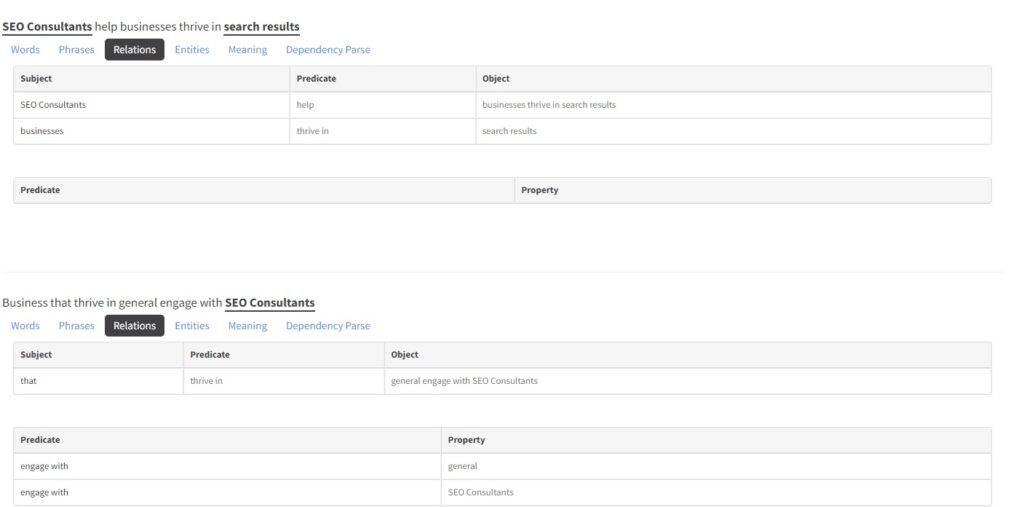
- “Consultants help businesses thrive in search results” – This sentence emphasizes the role of SEO consultants in enhancing a business’s search results.
- “Businesses that thrive in general engage with SEO Consultants” – This sentence suggests that successful businesses typically work with SEO consultants.
In semantic SEO terms, the first sentence is specific to consultants’ role, while the second implies a correlation between business success and SEO consultant engagement.
How Do Google’s Knowledge Graph and Bing’s Satori Enhance Semantic SEO?
Google’s Knowledge Graph and Bing’s Satori are integral to Semantic SEO. These systems gather vast amounts of data from different sources to build a network of entities and their interconnections, enhancing the search engines’ understanding of user queries.
They go beyond keywords to comprehend the context and intent behind searches, providing more accurate and relevant results. By mapping relationships between entities, they offer users a richer, more nuanced search experience, aligning with the principles of Semantic SEO.
Role of AI in Understanding Queries
What are RankBrain, BERT and MUM?
Google’s AI algorithms, RankBrain and BERT, are revolutionizing search by interpreting the nuances of human language, refining their understanding with every search, and providing increasingly relevant results.
Furthermore, The Multitask Unified Model (MUM) developed in May 2021, a thousand times more powerful than BERT, can understand and generate language across 75 languages and various tasks.
MUM’s multimodal capabilities allow it to understand information across multiple formats, improving search precision and reducing the number of searches needed to find an answer.
What is Natural Language Processing(NLP)?
Natural Language Processing allows search engines to understand nuances in language, transforming how content is interpreted and ranked. NLP and machine learning enable search engines to grasp search intent beyond keywords. With NLP, search engines can interpret complex queries and unstructured data. AI capabilities like structured data markup also provide additional context to help search engines understand content.
Could Google’s Search Generative Experience (SGE) be the Next Big Thing?
As of May 2023, Google has begun releasing a new form of search that’s powered by Generative AI. This is providing more precise, context-aware results, reducing the effort users need to find information. This is why Semantic SEO is crucial to us today if we want to be delivering more relevant results faster and more efficiently.
Trust in our digital agency’s mastery of Google’s ever-evolving algorithms. We prioritize Semantic SEO to keep you ahead — your success is our mission. Want to learn more? Contact our SEO experts today.
Practical Implications of Semantic SEO
In the Semantic SEO era, content creators are akin to chefs, crafting engaging narratives rather than just filling pages. Success hinges on authenticity, engagement, and value.
How To Optimize your content for Semantic SEO?
To optimize content for search, it’s essential to focus on the natural integration of semantic and long-tail keywords as they’re closer to natural speech,often forming questions or complete sentences.
Moreover, start incorporating Related Keywords and Synonyms.Using variations and related terms cater to a broader range of search queries while maintaining content’s natural flow.
Structured Data: This helps search engines decipher the context of content, making it more prominently featured, especially in rich snippets.
Curious about how this works in action? Check out this case study here:
By consistently offering valuable and relevant content, your site builds authority, gaining favor with search engines.
“By creating semantically- and topically-rich content, site owners can see significant improvements in their overall SEO performance.” – Search Engine Journal
At TBS Marketing, we specialize in crafting content that’s not only rich in semantic quality but also poised to rank high on Google. Ready to elevate your content strategy?Reach out to us today for more .
The Rise of Voice Search and Conversational Queries
“Hey, Siri!” or “Okay, Google!” is more than a call to action – it’s a testament to the changing way we interact with search engines.
The rise of voice search is a crucial frontier in Semantic SEO, understanding and responding to natural, conversational queries.
Finding Your Voice:
- Conversational Content: Crafting content in a conversational tone, as if speaking directly with the reader, caters to voice search queries.
- Question-Based Content: Most voice searches are questions. “How do I…?” or “Where can I…?” Optimizing content to answer these questions directly can improve its relevance.
- Local SEO: Voice searches are often local, e.g., “near me” or “close by.” Optimizing for local SEO becomes increasingly important

The Future is Semantic
Semantic SEO is more than a methodology; it’s a mindset. It encourages us to step into our audience’s shoes, understand their journey, and craft experiences that resonate on a human level.
As we step into the future, we carry the essence of what makes content powerful: connection.
In this digitally-woven world, staying visible means staying relevant, empathetic, and relentlessly innovative.
So, we adapt, evolve, and grow, ready to meet our audience where they are, with content that speaks to and for them.
Embark on a transformative journey with TBS MARKETING, where innovation in Semantic SEO awaits. Reach out today, and let’s pioneer your website’s path to unprecedented success!
